Search This Blog

Showing posts with label Japan. Show all posts

A Brief history of Sushi


The original type of sushi was first developed in Southeast Asia as a means of preserving fish in fermented rice. The History of sushi in Japan began around the 8th century.
The original type of sushi, known today as narezushi (fermented sushi), was first developed in Southeast Asia and spread to south China before introduced to Japan sometime around the 8th century. Fish was salted and wrapped in fermented rice. Narezushi was made of this gutted fish stored in fermented rice for months at a time for preservation. The fermentation of the rice prevented the fish from spoiling. The fermented rice was discarded and fish was the only part consumed. This early type of sushi became an important source of protein for the Japanese.
The Japanese preferred to eat fish with rice, known as namanare or namanari (semi-fermented). Namanare was partly raw fish wrapped in rice, consumed fresh, before it changed flavor. This new way of consuming fish was no longer a form of preservation but rather a new dish in Japanese cuisine.
During the Edo period, a third type of sushi was introduced, haya-zushi (fast sushi). Haya-zushi was assembled so that both rice and fish could be consumed at the same time, and the dish became unique to Japanese culture. It was the first time that rice was not being used for fermentation. Rice was now mixed with vinegar, with fish, vegetables and dried foodstuff added. This type of sushi is still very popular today. Each region utilizes local flavors to produce a variety of sushi that has been passed down for many generations.
When Tokyo was still known as Edo in the early 19th century, mobile food stalls run by street vendors became popular. During this period nigiri sushi was introduced, consisting of an oblong mound of rice with a slice of fish draped over it. After the Great Kanto earthquake in 1923, nigiri sushi chefs were displaced from Edo throughout Japan, popularizing the dish throughout the country.
Today the sushi dish internationally known as "sushi" (nigiri zushi; Kantō variety) is a fast food invented by Hanaya Yohei in today's Tokyo. People in Tokyo were living in haste even a hundred years ago. The nigiri zushi invented by Hanaya was not fermented and could be eaten using the fingers or chopsticks. It was an early form of fast food that could be eaten in public or in the theater.
Is your mouth watering already? Head over to Shiro today and try some sushi- made of the freshest, finest ingredients.

Japanese food etiquette

Here are our tips on mannerisms and etiquette to follow when eating Japanese cuisine in Japan.

It begins before you’ve even completed your order. While elsewhere in the world we’re accustomed to asking for variations and custom orders in a restaurant, in Japan it’s ill-mannered to ask for alternatives, and regarded as an insult to the chef.  Prior to starting a meal it’s a custom to say Itadakimasu, which translates as “I gratefully receive”, and to conclude a meal Gochisosama-deshita, “Thank you for the meal.” Be sure to say both to show your respect for the chef and your dining companions.

In Japan there are several customs you need to be aware of when enjoying a meal – not following table manners can get you questionable looks from locals.

If like many people, you struggle to eat sushi with chopsticks, you’ll be grateful to know the tradition of eating sushi is actually with your hands. Attempt to eat Nigiri in one bite; separating sushi ruins the perfection of the carefully-prepared sushi. Upturn the sushi when dipping into soya sauce so the raw fish absorbs the sauce rather than the rice; this enhances the flavors without making it too salty. However, if you still want to use Western utensils, ask for Naifu (knife) and Supun (spoon) which will ensure you get hearty bites and nothing should fall out.

While it’s rude in the West to noisily slurp a bowl of ramen noodles or soup, the opposite is true in Japan – it confirms to the chef that the diner is enjoying the meal.  To avoid dropping food, it’s courteous to lift the bowl of rice or soup and finish everything, even the last tiny grain of rice. Be careful not to place your chopsticks vertically in a bowl as it signifies a Buddhist funerary, and is disrespectful at a restaurant. Placing your chopsticks horizontally flat on your plate or bowl signifies you have completed your meal. Vegetarians should be cautious when eating food in Japan as many dishes are flavored with Dashi “stock”, made from fish oil. Eggs are also considered vegetarian so be careful when you’re ordering.

When indulging in alcoholic beverages, it’s the norm to first pour your acquaintance’s drink and then wait for your friend to pour your beverage. When you want to replenish your drink, hold your glass out to your friend.  Prior to enjoying a drink it’s tradition to say Kampai (cheers). At the end of the meal, you don’t need to leave a tip – in Japan most people feel uncomfortable when being offered a gratuity.
Courtesy Link: http://bit.ly/sbz0Qf

Some Korean food for thought!


Whether you are planning to eat in a Korean restaurant, or cook your own Korean food at home, this quick introduction to Korean cuisine will give you all the basics you need.


The Side Dishes

Korean food stands out from other cuisines with the many side dishes (banchan) that are served during meals. The number of side dishes can range anywhere from 2 to 12, but everyday meals feature at least a few. So when you eat at a Korean restaurant, your various side dishes will come to you before your meal in small bowls, and can be anything from vegetables to meat to seafood prepared in any number of ways. Korean dishes are all served at the same time, so there are no separate courses like in Western cuisines.

The Basics

The Korean food fest at Shiro Delhi

Rice is the backbone of almost every Korean meal. On rare occasions, noodles will replace the rice, but the vast majority of the time, every person eats a bowl of rice with their meal. Typically, each person will also have their own bowl of soup or stew. The side dishes and main dish or dishes, which can be meat, seafood, or tofu are all be served family-style in the middle of the table. Sometimes a large stew will replace the main dish and will be served family-style at the table.

Common Ingredients

Koreans have perfected the art of preserving food over thousands of years, so many of the side dishes are pickled, salted, or fermented and many are spicy. Kimchi, Korea's famous spicy cabbage, has over a hundred varieties with different vegetables, including some non-spicy types. Even though Korean stews and soups are served very hot (almost boiling), many of the side dishes are served cold or at room temperature.
The most common spices and sauces used in Korean cuisine are: sesame oil, chili pepper paste (kochujang), chili pepper flakes (kochukaru), soybean paste (daenjang), soy sauce, garlic, ginger, and scallions. As a result, much of Korean cuisine is intensely flavored, savory, and bold.

The Little Things

Everything, including meat and poultry, is cut into bite-sised pieces so there is no need for a knife. Korean food is traditionally eaten with stainless steel chopsticks and a long stainless steel spoon and is traditionally served at a low table with people sitting on the floor.

Some Korean Culinary History

Korean cuisine has been affected by its geography (peninsula), climate (hot, humid summers and very cold winters), proximity to neighbors China and Japan, and the Japanese occupation from 1910-1945. European traders also had an impact in the cuisine with the Portuguese introduction of chili peppers to Korea in the 17th century. By the 18th century, chili peppers were already being widely used in the preparation of Korean cuisine.

I hope you enjoyed reading this! We recommend you try the delectable Korean cuisine served at our Shiro Restaurant 
Where? Location: 
Shiro Restaurant, 
Kautilya Marg Poolside, 
Hotel Samrat Cafe, 
Chanakyapuri, 
New Delhi 

Japanese Food for the Soul


All About Japanese food!

The typical Japanese cuisine comprises rice, meat, vegetables and fish. The Japanese emphasize more on the quality of the food and presentation. Let us now take a look at the interesting facts about Japanese food.

Sashimi Salad at Shiro

1. Large amount of raw food is used in the Japanese cuisine. In fact, you must be aware that the fish served with sushi is raw.

2. Dried sardines and almonds are often consumed as snacks in most of the parts of Japan.

3. About 50% of the fish catch and 80% of the tuna catch is undertaken by the Japanese.

4. The quality of 'sashimi' or the very thinly sliced raw fish which is served with sushi, is never ever compromised with in an authentic Japanese restaurant. In some cases, the fish is kept alive in water, and sliced and served only on ordering!

5. Talking about sashimi, a sushi chef needs to be extremely careful when slicing the raw fish. In fact, a professional chef's knife is sharpened every day to have those thinly sliced fish, suitable for the exotic sushi.

6. Rice forms the integral part of the Japanese cuisine and we have different forms of rice dishes like the Kayu rice, Donburi, fried rice, Kare raisu, etc., that are popular all over the world.

7. The typical Japanese meal consists of rice, served with meat, fish or vegetables. Pickles and soup also forms a part of the traditional Japanese meal.

8. Now one of the amusing facts about Japanese food and drink is that it is considered good manners to slurp noodles in soup like Ramen. However, one is not expected to slurp only the soup, like the miso.

9. Talking of miso soup, the soup is very good for digestion and hence, should be eaten at the beginning of the meal; and not at the end.

10. Just like Chinese cuisine, chopsticks are used to eat several Japanese dishes. However, one should remember to follow the chopsticks etiquette when using them in formal events. It is rude to insert the chopsticks straight (vertically) into the food.

I hope you enjoyed reading these facts about Japanese food.Well, lastly, one of the unique features of the Japanese food is that you will either love it or hate it, there is no middle ground. So, why not try it and decide for yourself? 

Learn the basics of Sushi and Sashimi!


Te-Mari Sushi was apparently made popular in Kyoto first where gastronomy is more “feminine” than in any other part of Japan. It is very easy to make, present and carry.

It is more welcome when you realize people in Kyoto have more socializing to do than anywhere else, including eating and drinking. Making portions smaller and more artistic are a necessity there!
Actually Te-Mari Sushi can be made in any size and include any ingredients, be it for omnivores, adults, ladies, children, vegetarian or vegans!

Simple techniques you can follow!

The technique is simple enough: having prepared the sushi rice, take a piece of cellophane paper and first put the tane/topping outer surface down, then place some rice over it. Close the cellphane paper by twisting it and press the sushi into a ball (mari) in your hand (te)! Unwrap it, place it on a plate, tray or in a box and add some more topping if neceassary!

For a tea party? For a lady's bento? For a gentlemen's bento or a European American style party, the delectable Sushi is the all time favourite comfort Japanese food!

Source: http://bit.ly/igODQo 


10 Things you may not know about Sake


Love Sake? We bring you some interesting highlights!

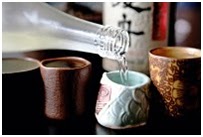
1.The appropriate way to sip sake is not hot and dunked into a mug of beer, but rather, cold. In Japan, sake is served chilled. Because heating it will mask the flavor, if sake is offered hot, that means it’s poor quality, bad-tasting sake.


2. All sake needs a special mold to ferment. It’s called the koji mold. At SakeOne, they hand-mix the koji into the rice to help break down the starches.


3. The water that’s used to make sake is more important than the rice. Only the purest of water can be employed, as it directly affects the taste and quality of the sake.

4. Although sake is known as rice wine, its production is more similar to beer than wine.

5. To make a batch of sake, the entire process of brewing, fermentation, and maturing takes three weeks.

6. Sake has a great range and can give extra dimension to many different types of cuisine. When serving it, think beyond sushi. It paired surprisingly well with a variety of cheeses.

7. Traditional sake glasses have concentric rings on the bottom of the glass. This is to see the clarity of the alcohol.

8. Sakes are great for mixology and can be used to add depth and flavor to cocktails.

9. Nigori is unfiltered sake, which is why it has a cloudy white color.

10. Sake does not age well and should be enjoyed within a year of purchasing.